Difficult People Aren't Always the Problem
A two-part approach to working with people who pull a negative reaction out of you
By Elina and TK | The Development Journal ·
This article is a collaboration between TK, the author of The Development Journal, and Elina, the author of Leadership Capability System.
TK writes for professionals navigating complex transitions that can cause stuckness and burnout. The newsletter explores this through the lens of purpose, identity, and adult development.
Elina writes for managers stuck between knowing and doing. Leadership Capability System publication breaks leadership down to the practice level, one capability at a time.
Some people are easy to work with. And then there is the person you do not like.
The difficult one, the political one, the one who does not get it. You disagree with them and something about them pulls a reaction out of you before you have even decided to react. You would keep your distance if you could, except you cannot, because you need to influence them, or collaborate with them, or lead them, or be managed by them. So you have to find a way to work with the person you would cross the street to avoid.
We want to offer two moves for those situations. Not a recipe, and not something to work through in order, more like two things to reach for when you are stuck with someone you find hard. We call them the Lens and the Mirror.
The Lens
When we find someone difficult, it usually starts at the level of sensation: I don’t trust them, I feel intimidated by them, something about the way they talk frustrates me. We feel the difficulty before we can name it, and by the time we can name it the impression has already been set, and from then on we see the person through it.
So, the first move is to notice that we are looking through something, and then to change it. Imagine picking up a wider lens, one that gives the person and your work together a bit more curiosity, more space for a different reading. Instead of an irritating or intimidating or lazy character, you start to consider someone who is simply operating from a very different working model.
Bill Torbert gave this a useful name, action logic. The phrase carries the idea on its own, there is a logic behind what people do, and that logic can differ from yours. The drivers are different, the way someone makes sense of a situation is different. Torbert described several profiles, each running its own action logic. The Diplomat cares about keeping harmony, holding the routine steady, protecting a sense of orderly certainty. The Achiever is pulled towards the objective and is willing to pay for it, with conflict, with a change of direction, with disruption to the very routine the Diplomat is trying to protect. Put those two in a room with no sense of the logic each one is running, and they will find each other impossible. One is breaking things and creating chaos. The other is slow and short-sighted.
Seeing the behaviour as a different action logic rather than as something illogical changes what happens inside you: the emotional charge drops, you stop bracing against an attack on the right way to do things.
But the most important thing the lens does is not what it lets you see, it is that you can see the lens itself. You picked it up, and the profile you have placed on the other person, your reading of their logic, your sense of what drives them, is still your assumption.
And there is something else that happens once you notice the lens. You realise you have been looking through one all along, which means some of what you have been seeing in this person has been shaped by where you are standing.
The Mirror
The “lenses” which we default to, are a common cause for miscommunication or lack of connection.
Another common cause is when what we see and understand are fundamentally different.
When someone expresses a value, belief, or a method that opposes your own, it can be very difficult to take in. Like that oft-used image of two people seeing very different things…
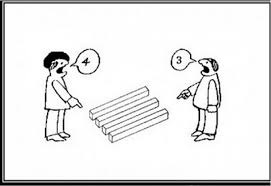
…resolution reaches an impasse when what we see is fundamentally different.
And this isn’t just about how we observe the issue at hand. How we operate in the world is a reflection of our internal values, our experiences, our assumptions, our ‘truths’ and ‘best practices’, our fears, our protective behaviours and our desires for validation.
Two very different internal worlds cannot be brought to resolve an issue with communication methods alone.
So what is the key?
Often influencing someone is more about how willing you are to be influenced yourself.
When we can take an objective look at our own assumptions (which admittedly can be hard to do, but very possible with reflection and feedback), their grip on us begins to loosen. And when they loosen, we also become a little more open to different ways of seeing and being.
This, by the way, is a fundamental process in adult development. When we are “Subject to” our assumptions, they control us and define us. It’s like a fish born in muddy water. They just assume that’s how the world is. But when we slowly make our assumptions “Object”, we realize it’s just one of many ways we can “see” the world (the fish has now jumped out of the water and noticed the neighbouring pond is a different colour). Life becomes more expansive, and we become a little less attached to specific ways of doing things.
We aren’t “throwing away” or denying our old assumptions or methods when this happens. They just become one option out of many. We can adaptively pick and choose from amongst them, based on the situation.
And how can we objectively “see” our assumptions?
One way is to see others as mirrors- especially those we find particularly difficult to connect with or understand.
“What is it about their way of handling things that doesn’t sit well with me?”
“Is it fundamentally wrong? How might their way be a helpful way to navigate life?”
“What are things about myself that I can see in that person? What are things about them that are actually within me?”
“Given my answers to the above, are my assumptions and standards fundamentally true or better?
The answers to these questions will vary in depth and insight depending on the situation. But consistently using them whenever tensions in communication occur, can gradually loosen the grip that our assumptions have on us.
By letting others expand our way of seeing things, it allows us to find commonalities between “us” and “them” that invites connection. And that connection is often what allows us to see each other, understand each other, and influence each other in a constructive way.
What are your experiences with tension in communication? What has consistently worked for you when working with diverse personalities?
If this resonated, the next step is practice. The skill this article is about is choosing your lens in order to influence and work effectively with others; this is something that takes deliberate practice. I have put together a Capability Practice Guide on influencing stakeholders, taking you through Notice, Experiment, and Integrate. Free for subscribers, instant download. 👉 Free Practice Guide: Influencing Stakeholders
Originally published on Substack.